On July 14, 2026, Prax Health co-hosted "Starting a Private Practice: A Launch Checklist for Nurse Practitioners" with the American Nurses Association, part of ANA's webinar series The APRN Advantage: Redefining Practice in 2026. The audience included APRNs across the nation and covered practice setup, entity formation, payer enrollment, insurance billing and building a sustainable patient base. APRNPs can sign up for upcoming APRN webinar sessions in the series here.
The session was built for Advanced Practice Registered Nurses (APRNs) considering their first practice, and it was organized around the six questions nurse practitioners (NPs) ask most. Two practicing NPs who own their practices answered them alongside Prax Health CEO Meghan Jewitt. Here is the overview or checklist of questions:
The July 14 session, part of the American Nurses Association's webinar series The APRN Advantage: Redefining Practice in 2026.
| Question | Quick answer |
|---|---|
| Can NPs own a private practice? | Yes, in every state, when the entity is set up correctly. A Nursing PC or PLLC is the most common structure. |
| Do NPs need a collaborating physician? | Only in some states. It is a clinical agreement and never decides who owns the practice. |
| What has to be in place first? | Your entity and legal documents, malpractice insurance, and a collaborating agreement (where appropriate). |
| How long does it take? | Entity in about 1 to 2 weeks in most states (a few states can take 3 to 6 months or more). Payer credentialing runs 1 to 6 months per payer. |
Can nurse practitioners own their own practice?
Yes. In every state, when the practice is set up the right way. For most NPs that means a Nursing Professional Corporation (PC) or a Professional Limited Liability Company (PLLC). In both cases, these are practice entities regulated by the Board of Nursing and 100% owned by you.
The exception is the MSO-PC model, a two-entity structure used in special cases, for example certain states or non-clinical co-owners.
Do NPs need a collaborating physician?
Only in some states, and it never decides who owns your practice. Per the American Association of Nurse Practitioners' (AANP) 2026 State Practice Environment map (updated May 2026), 28 states, Washington, D.C. and several U.S. territories grant NPs full practice authority; the remaining states require a collaborative or supervisory relationship.
Overall, we expect more states to move toward more autonomy: for example, seven states have expanded NP practice authority since mid-2021, most recently New Jersey in 2026.
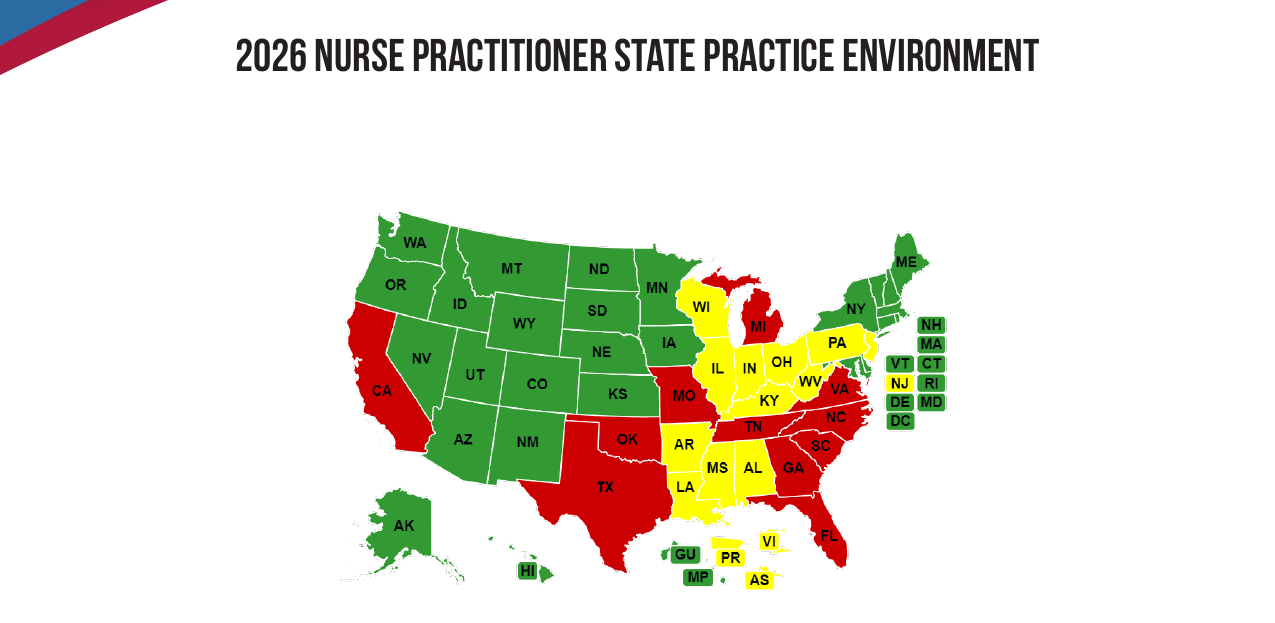
AANP 2026 Nurse Practitioner State Practice Environment, updated May 2026. Source: aanp.org.
Where a collaborator is required, it is a clinical agreement that defines scope, standardized procedures and prescriptive authority. It does not impact your entity or your ownership structure.
What has to be in place before the first patient?
Three things: your entity and documents, your malpractice coverage, and your collaborating agreement (where appropriate). That means an entity filed correctly in your state with governing documents (or bylaws) written for healthcare, the critical consent forms (HIPAA, informed consent, telehealth, financial agreement, etc.), and an EIN so you can open a business bank account. On coverage, most payers require $1M/$3M malpractice limits to enroll in insurance. Collaborations are state-specific and the regulations are frequently changing, so if you have questions, we do recommend talking with a group like Prax or a group that specializes in collaborations.
How long does it take to start an NP practice?
Plan in quarters, and start insurance enrollment early. In most states, the entity, EIN and malpractice quotes come together in a week or two (a few states, such as New York, run three to six months, or longer). EHR setup, consents and first cash-pay visits are possible by weeks two to six. Insurance enrollment frequently takes longer. The panel's key point: insurance often determines how quickly you can grow, not whether you open.
Who should handle billing?
Billing is more than submitting claims, and submitting is the easy, automated part. The work is everything after: coding review, following up on denials, following up on underpayments, revenue reconciliation and revenue reporting.
The benchmark shared in the session: practices that do not check every claim against contracted rates commonly lose 15 to 20% of insurance revenue. Whoever bills for you, ask how they catch and handle denials and underpayments, what metrics they track, and whether you can verify payments yourself.
Where do patients come from?
In the panelists' experience, being in-network fills a panel five times faster than cash pay alone, and they framed insurance enrollment as marketing, not paperwork. Booking channels like Zocdoc and Psychology Today bring high-intent patients when managed closely. And an in-person option matters: the session cited that 80% of patients prefer a provider who offers in-person visits, even when they book telehealth. Retention compounds all of these efforts.
How do I start my own NP practice? Start with the checklist
Starting your own practice has never been easier. If you want more insight, including NP launch stories and Q&A, register for upcoming sessions in the American Nurses Association's APRN Advantage series here. At Prax Health, launching and running NP practices is what we do all day: entity formation, insurance enrollment, EHR, and billing and claims, done right from day one.
Disclaimer: The information and/or resources provided in this post and elsewhere on the Prax Health site is provided for general informational purposes only and to assist you as you evaluate engaging in Prax Health’s services. It is not intended as, and Prax Health, Inc. does not provide, medical advice, diagnosis or treatment nor is it intended to be legal or tax advice.
Sources
- "Starting a Private Practice: A Launch Checklist for Nurse Practitioners," The APRN Advantage: Redefining Practice in 2026, American Nurses Association, July 14, 2026 (webinar)
- 2026 Nurse Practitioner State Practice Environment (map), American Association of Nurse Practitioners, updated May 2026
- State Practice Environment (interactive), American Association of Nurse Practitioners, updated May 2026